Skip to content

Does LVMH Own Beverly Hills? A $1B Real Estate Power Play Says Yes.

LVMH’s real estate strategy in Beverly Hills transcends mere retail; it's a calculated fight to own luxury corridors, redefining brand equity and challenging competitors to rethink their leasing habits.

Does LVMH Own Beverly Hills? A $1B Real Estate Power Play Says Yes.
Photo by Rahul Bhogal / Unsplash
Published:

LVMH’s recent activity on Rodeo Drive reflects a broader capital allocation strategy that blurs the lines between brand investment and long-term asset positioning. The conglomerate is aggressively acquiring high-value, flagship real estate in global luxury corridors—most notably Beverly Hills—not only to enhance its experiential retail presence but also to consolidate long-term margin protection and balance sheet control. This dual strategy mirrors the thinking of institutional real estate investors and top-tier brand strategists alike. Below, I evaluate this move through both strategic and financial lenses.1
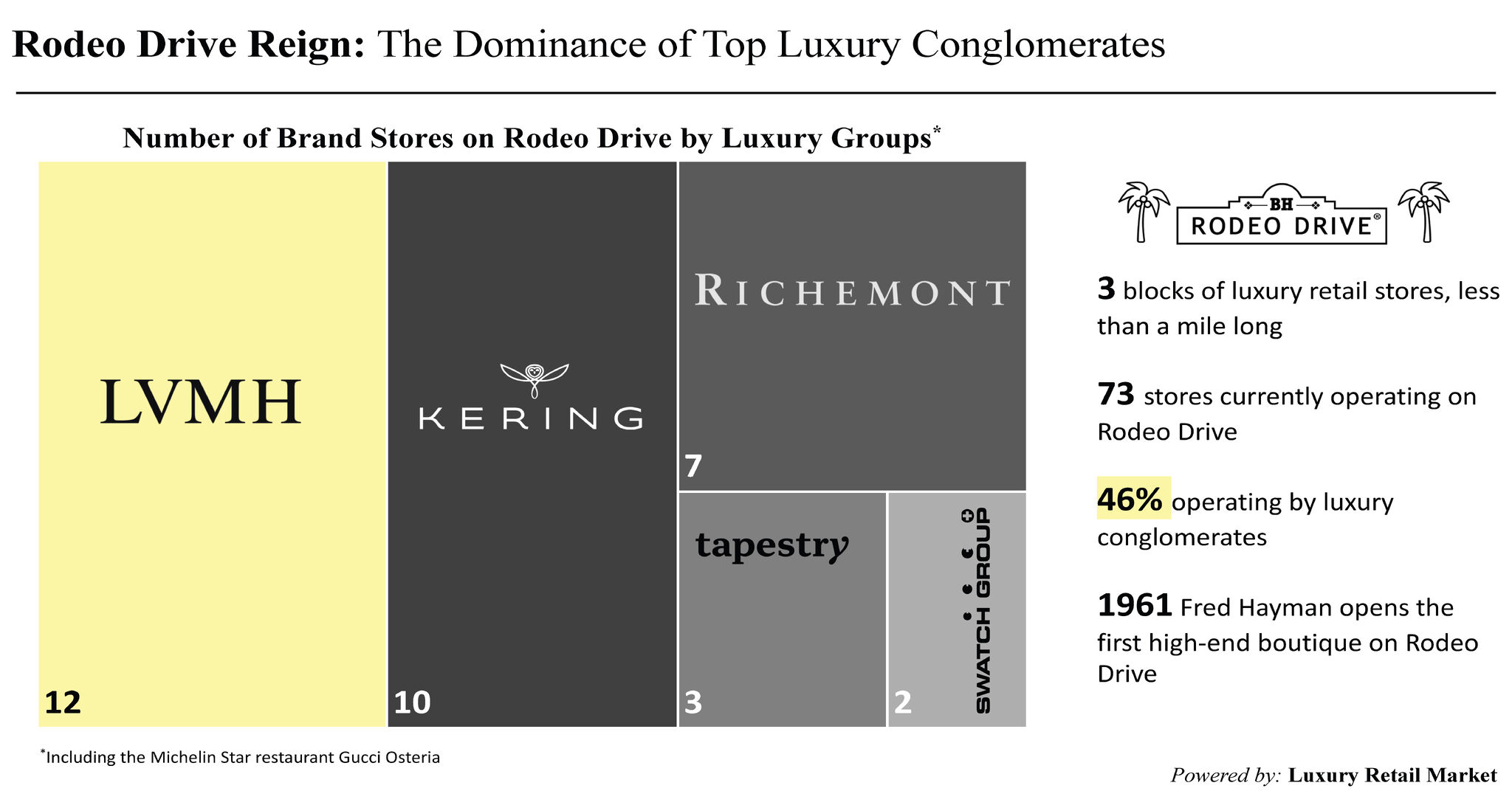
Includes leases and owned branded stores

Strategic Overview: Why Ownership over Leasing?

For a luxury group like LVMH, acquiring flagship real estate offers a strategic hedge against market volatility, rent escalation, and inconsistent landlord standards. Ownership provides multi-decade brand control over key physical touchpoints. In a category where the physical store is both showroom and stage, controlling the real estate becomes synonymous with protecting the brand.

On the upside, owning:

On the downside:

The decision calculus depends on LVMH’s capital structure and appetite for duration risk—both of which are robust. The group’s liquidity and operating margins enable it to treat flagship locations as strategic, yield-adjusted real estate holdings.

P&L and Capital Modeling: Own vs. Lease Economics

To better visualize the financial rationale behind LVMH's ownership strategy, I bifurcated a Rodeo Drive flagship into a two-part framework:

1) Key Assumptions

This simplified model omits taxes, rents on land, and other nuances, but highlights key effects: owning greatly lifts EBITDA, while leasing burdens it.

2) Strategic Implications

This structure highlights how flagship ownership behaves more like a capital asset play than a pure retail P&L operation, positioning LVMH to maximize strategic and financial returns over time.

Key takeaway: Moving rent to the balance sheet as capitalized real estate significantly expands EBITDA, although the impact on net income depends on the financing structure and depreciation. This structure aligns more closely with a private equity model in real estate than with traditional retail operations. Over time, capital appreciation on land values adds a further unbooked benefit—relevant in Rodeo Drive's appreciating corridor.

LVMH's Real Estate Portfolio in Beverly Hills

LVMH has quietly executed an acquisition strategy that resembles a REIT playbook, amassing over $900M in Beverly Hills real estate since 2013. The portfolio includes multiple contiguous parcels across Rodeo Drive and Beverly Drive, forming a real estate campus anchored by the upcoming Louis Vuitton mega-flagship.

Residential Holdings: Bernard Arnault’s Personal Real Estate Strategy in Beverly Hills

Image by The Real Deal

Notably, LVMH’s corporate acquisitions in Beverly Hills are mirrored by Bernard Arnault’s, Chairman & CEO of LVMH, personal real estate strategy. Over the past decade, Arnault has assembled a portfolio of residential properties in the ultra-exclusive Trousdale Estates, Bird Streets and Beverly Hills Post Office neighborhoods. His holdings include4:

These acquisitions, totaling over $180M, suggest a coordinated vision—blending professional and personal investments to secure influence in one of the most desirable markets in the world. Reports also indicate efforts to secure additional permits, possibly for a private tennis court, which would further consolidate control over adjacent parcels.

Together, these residential and commercial holdings reinforce Arnault’s and LVMH’s conviction in Beverly Hills—not just as a retail opportunity but as a long-term strategic stronghold.

LRM is a 501 (c)(3) nonprofit

Every contribution—large or small—fuels our mission. All donations are tax-deductible. Click below:

Donate

Global Comparison

LVMH's real estate strategy in Beverly Hills parallels its tactics in other luxury capitals.

In Paris, LVMH reimagined Dior's historic flagship at 30 Avenue Montaigne as a cultural complex. The store includes a museum, restaurant, private suite, and rooftop garden. This "experience center" model underscores how owning real estate enables LVMH to turn boutiques into destination venues. Even rivals jump into the fray: Chanel recently bought a building on Montaigne to expand its presence.

On New York's Fifth Avenue, LVMH's footprint is also growing. The Tiffany acquisition brought the iconic 727 Fifth Avenue store onto LVMH's balance sheet, and the company was reported as a bidder for 745 Fifth (Bergdorf Goodman's building.6 Fifth Avenue retail rents ($ 2,000/sq. ft.)7 exceed Rodeo's, so owning locks in operating costs.

In Tokyo's Ginza, LVMH is likewise investing heavily. In October 2024, it paid ¥40 billion ($276M) to acquire the Abercrombie & Fitch flagship building, ensuring a prime presence in the world's second‑largest luxury market.8 With LVMH brands (Dior, Fendi, etc.) already occupying several Ginza addresses, this purchase solidifies ownership of the "Shinjuku of luxury" by a foreign retailer. (A new Tiffany flagship – "Asia's largest" – will open nearby under LVMH's umbrella as well.) These global examples illustrate a common theme: luxury conglomerates are purchasing marquee retail real estate as long-term brand anchors rather than treating stores as disposable leases.

Strategic Implication: LVMH as Operator + Landlord

For LVMH, owning real estate is not a defensive hedge—it's a long-duration strategic asset class. It aligns with:

This approach applies pressure on peers like Kering, Richemont, Hermes of Paris and Chanel to rethink retail real estate not just as a leased channel but as a permanent brand equity multiplier. In the long term, Rodeo Drive may be less about leases—and more about who owns the street.

Looking Ahead: Part 3 Preview

In the next installment, I will benchmark the real estate strategies of LVMH's key competitors:

I’ll explore how these strategies compare in terms of capital deployment, margin uplift, and long-term brand equity—and what they signal about the future of luxury retail investment.


What's your take?

LVMH's strategy raises a fundamental question: Should luxury brands own the streets on which they sell?

📊 As a reader of this newsletter, your perspective adds real value. This 5-question pulse check is designed to gather insight from those shaping the future of luxury retail.

If you're a luxury retail leader, real estate strategist, or brand operator—take 60 seconds to weigh in. Your perspective will help shape the next chapter in this ongoing series on capital strategy, brand equity, and retail asset control.

👇 Cast your vote below:


Sources:

1

cbre.com

2

Globest.com

3

Apparelnews.net

4

citysignal.com

5

Morningstar.com

6

cbre.com

7

Globest.com

8

voguebusiness.com

Robert Gutierrez Jr.

Robert Gutierrez Jr.

Blending academic research + frontline experience to understand how organizations how shape experiences for employees & customers.

All articles

More in Luxury Retail Market

See all

More from Robert Gutierrez Jr.

See all