
Louis Vuitton is planning a 100,000-sq-ft "mega-flagship" on Rodeo Drive, set for 2029. The Frank Gehry–designed exterior (a sculptural, white "lotus" façade) and Peter Marino interiors will house full men's, women's, jewelry, and travel collections – plus a café, galleries, and a 100-seat rooftop restaurant.
Louis Vuitton's Beverly Hills Legacy
Louis Vuitton's presence on Rodeo Drive dates back to the early 1980s, marking its commitment to the burgeoning luxury market in Beverly Hills. The Beverly Hills store became a top-performing flagship under the leadership of Ron Michaels during the 1990s through the early 2000s. Michaels' visionary retail leadership and deep understanding of the Southern California luxury clientele were instrumental in securing the maison's current location at 295 North Rodeo Drive—a cornerstone of the brand's West Coast presence.
Over time, the store evolved from a traditional retail outpost into a modern, architectural icon that now includes immersive client experiences, high jewelry salons, and exclusive capsule offerings. The Beverly Hills flagship remains one of Louis Vuitton's most strategic doors globally for sales volume and UHNW engagement.
Visualizing Louis Vuitton’s new Beverly Hills Flagship: A Dual-Entry Experience
LVMH says the new store will deliver a "full Louis Vuitton lifestyle experience," with a permanent exhibition space and branded eateries. In other words, this megastore is as much a brand statement and destination as a high-volume retail experiential store.1
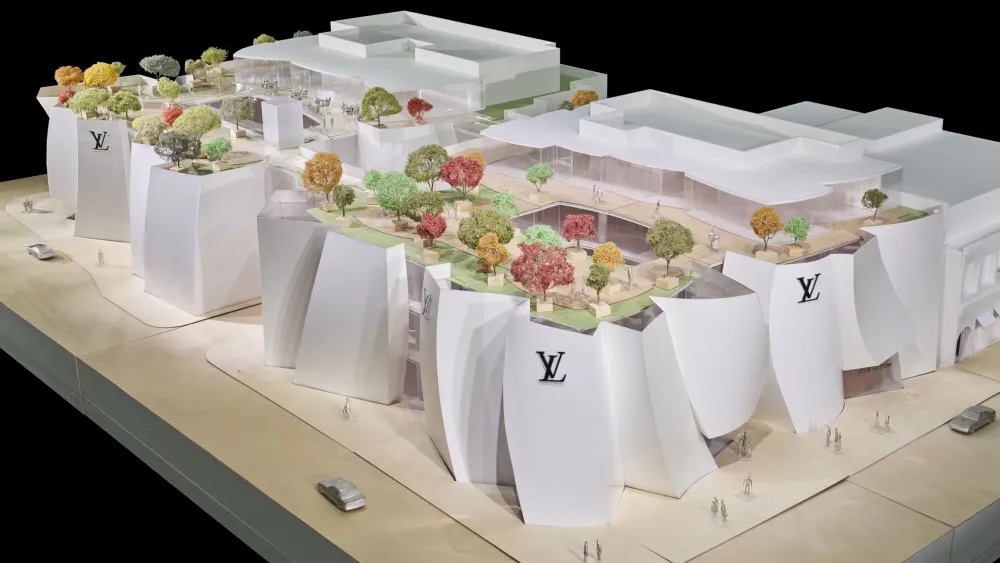
To help visualize the scale and spatial logic of Louis Vuitton's upcoming Beverly Hills flagship, imagine a dual-entry experience that spans an entire city block—from Rodeo Drive to Beverly Drive, linked by a skybridge for a seamless client journey.
On the Rodeo Drive side, the flagship will span approximately 45,000 square feet across three retail levels, each organized by strategic product verticals: Women's and Men's ready-to-wear, Travel, Watches and jewelry, and Beauty and fragrance. At the crown of this structure, a rooftop garden terrace and private client salons will serve as a high-touch hospitality zone, blurring the lines between commerce and experience.
On the opposite side of the block, the former Paley Center for Media at 465 North Beverly Drive—currently housing the Mr. Brainwash pop-up art exhibit—will be permanently repurposed into a 55,000 square-foot exhibition and hospitality venue. Accessed via Beverly Drive, this annex will feature:
- A ground-level café and exhibition lobby
- Two complete levels of immersive exhibition space
- A rooftop restaurant with indoor-outdoor seating and capacity for 100 guests, leveraging the region's climate for open-air dining
Critically, the two structures, divided by a pedestrian alleyway, will be connected via a bridging passageway, enabling uninterrupted circulation between retail and experiential zones. The architectural and operational strategy signals a broader ambition: to transform the flagship into a high-performance retail asset and a branded cultural landmark.
Two of the most valuable intersections within Beverly Hills’ Golden Triangle—Rodeo Drive at Santa Monica Boulevard and Beverly Drive at Santa Monica, will soon be anchored by a contiguous, high-touch Louis Vuitton retail ecosystem, transforming the district into a fully immersive brand destination.