
There is a particular kind of knowledge that only comes from being inside the room.
The one where a portfolio decision gets analyzed for months across Maisons and internal stakeholders with competing objectives, then ultimately gets made in a moment shaped by growth priorities, timing, market transitions, and other circumstances sometimes beyond control. The question is never simply where to open next, but where to commit fully, where to pull back, and where to rethink before the market shifts beneath you. Where to reinvest, expand, or relocate to capture better foot traffic, stronger co-tenancy, and a physical presence that actually reflects where a brand stands, or intends to stand.
This Foreword is a continuation of our 6-Chapter research series: The Structural Realignment of Luxury Retail & Commercial Real Estate
If you haven't already, click below to read the Preface:
 Robert Gutierrez Jr.
The industry is at an inflection point, one that will separate the brands and landlords who are reading the landscape clearly from those still operating on assumptions the market has already moved past. ICSC Las Vegas this May will bring that divide into sharp focus.
I spent three years building that judgment at Kering. My role sat at the corporate level above the individual houses, with visibility across Gucci, Saint Laurent, Bottega Veneta, Balenciaga, and the rest simultaneously.
That vantage point, during a period of significant internal and market complexity, taught me something that no period of stability could: the brands that endure are not the ones that move the fastest, but the ones that move with the most conviction. Rightsizing stores, sometimes within opening only twelve months prior. Renegotiating signed leases before construction began. Exiting markets that had once commanded serious investment but could no longer justify it. These are the type of decisions that define a portfolio, and they are far harder, and far more consequential, than any opening.
What made that work more nuanced than any market analysis could capture was the layered nature of the negotiations themselves. Not every brand arrives at the landlord's table with equal leverage. The landlords on the most coveted streets have their own hierarchy of preference, built over years of occupancy, volume, sales performance and brand prestige. That hierarchy shows up quietly but consequentially in which space gets offered first and to whom, and in deal terms. But leverage isn't only a function of brand strength. It is equally a function of relationship continuity, institutional reputation, and a track record of following through. Landlords extend their best opportunities to counterparts they trust, partners who are consistent, decisive, and whose word closes deals rather than reopens them. The groups that earn and protect that standing are the ones that get called first, and in this market, that call is everything.
Internally, the complexity compounds in ways that rarely surface publicly. Within a conglomerate, not every maison sits at the same table with the same weight. When multiple houses from the same group are competing for the same corridor, sometimes the same space, sometimes the same storefront visibility, the real estate team is navigating an internal hierarchy where one brand's strategic priority will, by necessity, shape what is available to another. Understanding that dynamic, and knowing how to work within it, is one of the most valuable and least discussed competencies in luxury real estate.
On the other end of the spectrum, I worked on the acquisition of 715-717 Fifth Avenue, a transaction that captures something essential about how luxury real estate decisions actually get made. The numbers were complex and the asset wasn't without compromise. But in corridors where prime corners are finite and competition is permanent, hesitation is its own kind of loss. When Hermès pays a record $400M for a building on Rodeo Drive (see article below), it reflects both realities at once: a location already outperforming its existing footprint, and a street in the middle of a transformation.
 Robert Gutierrez Jr.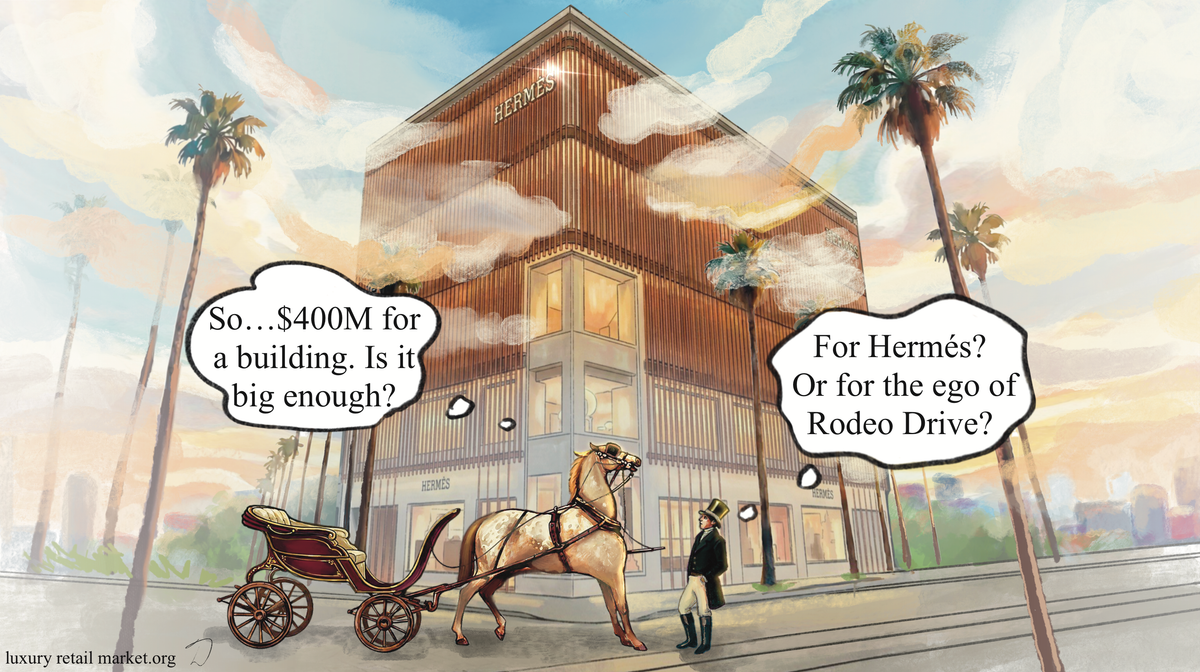
Block by block, flagship by flagship, into something far more monumental and cultural. The high street flagship of yesterday is becoming the mega-flagship of tomorrow. The brands that fail to anticipate that shift will find themselves outscaled not just physically, but experientially. You move with intention, or someone else defines the block for you.
The broader lesson I carried out of those years is one this series speaks to directly. Across the industry, the supercycle created conditions where momentum was too easily mistaken for strategy. Capital followed growth charts into markets and locations that looked compelling on paper but couldn't sustain the weight of an elevated brand. The best landlords on the best streets learned quickly which groups showed up as true partners: data-driven, relationship-oriented, and willing to make the harder call before circumstances forced it. That distinction shapes everything quietly, what gets offered, on what terms, and how much runway a brand has to build something lasting before the window closes.
The groups whose physical presence commands the most respect today were the most intentional. They understood that where a brand chooses to show up, and how completely it commits to that presence, is one of the most permanent statements it will ever make.
That conviction is what I bring to my work as a real estate strategist and consultant. Helping brands think through not just where to go, but whether to go, and how to show up in a way that reflects where they are headed. Connecting the right brands with the right spaces, and the right landlords with partners worth building for.
If you are a brand president deciding where to plant your flag for the next decade, a real estate director negotiating in corridors where the best spaces are already spoken for, or a landlord trying to understand which tenants will define your asset's long-term value, this series was written for the decisions you are making right now.
What has always been missing from the conversation around luxury retail, in the trades, in the press, in the panels at industry conferences, is the kind of analysis that treats these decisions with the financial and strategic seriousness they deserve. Luxury media is excellent at documenting the spectacle. The opening, the architect, the campaign. What it rarely does is interrogate the calculus behind the commitment, the market intelligence, the portfolio logic, the web of factors that determine whether a location becomes a landmark or a liability.
This 6-Chapter research series, The Structural Realignment of Luxury Retail & Commercial Real Estate, does that. It couldn't be more necessary or more useful as the industry prepares to converge in Las Vegas and take stock of where we are.
The industry has had no shortage of opinions about these markets. What it has lacked is this kind of rigorous, ground-level intelligence and perspective. In many ways, this series by Luxury Retail Market (LRM) captures what I spent three years navigating from the inside, the same markets, the same structural forces, the same decisions that defined portfolios and brands. Seeing it documented with this level of analytical depth and honesty is both validating and overdue.


