Skip to content

Who Really Pays the Most in Luxury Retail?

Luxury retail is reeling from staffing crises and leadership upheavals, forcing brands to rethink talent strategies amid rising pay transparency and generational workforce shifts.

Who Really Pays the Most in Luxury Retail?
Illustration by: Diana Anpilohova
Published:

Executive Summary

The Luxury Retail Compensation Intelligence Database is designed to provide an unparalleled view of pay structures in the luxury goods and fashion sector, grounded in transparency and comparative analysis.

Transparency in pay has become a critical issue in the luxury retail industry. To address this, we built the Luxury Retail Compensation Intelligence Database, a proprietary dataset designed to benchmark compensation across the industry.

Methodology: Building the Luxury Retail Compensation Intelligence Database

Key points:

It is the most transparent pay benchmarking tool in luxury retail today—curated LRM.

Database Access đź”’

LRM Patron Members have complete access to Luxury Retail Compensation Intelligence Database. If you are not part of the LRM community yet, click here to join.

To access the database, click the link below and enter your same email for LRM to receive a login code.

đź”— Access now: Luxury Retail Compensation Intelligence Database

Highlights from the Luxury Retail Compensation Intelligence Database

The following article is divided into two primary sections:

  1. Pay by Group — examining the compensation structures of LVMH, Richemont, Kering, and other conglomerates, with attention to their U.S. operations, talent initiatives, headcount, and the role of the American market in driving group performance.
  2. Pay by Top Brands — analyzing the salary ranges of Louis Vuitton, Hermès, Chanel, Gucci, Cartier, and others. Here, we contextualize compensation within broader industry shifts: leadership transitions, a multi-generational workforce, and the evolving need to upskill talent in line with modern retail demands.

Pay by Group – Global Luxury Conglomerates

The world’s biggest luxury groups – LVMH, Kering, and Richemont – collectively employ on the order of several hundred thousand people and generate well over €100 billion in annual sales.

Each group is highly focused on talent development. LVMH has launched a strategic “HR New Deal” (2024) to enhance learning, career path transparency, and leadership development within its Maisons. Kering similarly emphasizes ongoing training, mentoring, and internal mobility – “ongoing training, mentoring, career mobility: Kering gives you the tools you need to carve a varied and flexible career path”1 – to empower its employees. Richemont likewise invests in specialized institutes and trainee programs (for example, the Mustaqbalkom retail traineeship in the UAE) to build its talent pipeline.2In short, all three houses are aggressively recruiting and upskilling staff globally, recognizing that talent is a strategic asset.


The Luxury Retail Market is reader-supported. Your pledge helps sustain thoughtful research and independent insights that shape the future of luxury retail.


The United States is a crucial market for these conglomerates, often accounting for a large share of sales and growth. LVMH reported continued revenue growth in both Europe and the U.S. in 2024, and Chanel’s CFO recently noted that U.S. demand – while softening – was still increasing.3 In practice, America’s large luxury consumer base means all of these groups maintain significant U.S. headcount and retail networks. In summary, while each group operates on a global scale, the health of the U.S. market is vital – it serves as a bellwether for demand and a competitive battleground for talent.

This chart compares top-end average base compensation for in-store and corporate roles across the three luxury groups. The data will vary over time and become more significant as new jobs with salaries are added quarterly.

However, this strength coincides with serious industry-wide staffing challenges. Luxury retail is facing a labor shortage and retention crisis. Recent studies indicate that approximately half of luxury retail employees plan to leave their jobs, according to cxg.com. According to 2023 U.S. data, there are 2.5 million more retail vacancies than available workers, and 44% of U.S. retail workers intend to leave within the next few months.4 This tight labor market has luxury firms scrambling; LVMH alone says it must hire 22,000 new store employees by the end of 2025 to fill gaps. In practice, these shortages make it more challenging to staff sales positions, which risks leaving luxury stores understaffed. To counteract this, the luxury groups are boosting career appeal – for example, by opening up internal promotion (LVMH aims to let employees apply for 75% of openings lvmh.com), providing apprenticeships (LVMH’s Métiers d’Excellence institutes train artisans), and offering more stable benefits – in hopes of countering the perception that retail is not a prestigious career. In summary, the big luxury groups are financially strong and US-centric, but they recognize that nurturing talent is now a strategic imperative amidst broad retail labor pressures.

Pay by Top Brands – Iconic Houses and Workforce Dynamics

Within these groups and among top brands outside, such as Louis Vuitton, Hermès, Chanel, and Gucci, similar talent issues are faced, which are amplified by rapid leadership turnover and a diverse workforce. In recent years, luxury has seen revolving doors at the top. For example, Gucci (Kering’s flagship) has changed creative directors twice in as many years: Alessandro Michele departed in late 2022 and was replaced by Sabato De Sarno in 2023, who himself left in early 2025. Gucci’s CEO also changed, with Stefano Cantino starting in January 2025. Chanel has also shuffled its executives: the U.S. President and UK boss both left during Leena Nair’s tenure, and internal reports describe it as a “changing of the guard.” Even legacy houses like Hermès and Chanel rarely see such churn, making these recent moves notable. In summary, brands are frequently refreshing their leadership in response to market shifts, which means that continuity of strategy and culture can be both a challenge and an opportunity.

At the same time, luxury retail now relies on a truly multi-generational workforce. LVMH notes that its team spans four generations, with workers ranging from Gen X (40–55 years old) to millennials (25–40 years old) and Gen Z (18–24 years old). These cohorts have different priorities: Deloitte reports that Gen Z and millennials highly value learning and development, as well as work-life balance. Indeed, younger luxury retail staff often seek meaningful career paths and training opportunities over mere title or income. Brands are responding by overhauling their talent acquisition and development processes. For example, Kering emphasizes “ongoing training, mentoring, career mobility” so that “each employee can steer their own career path.”

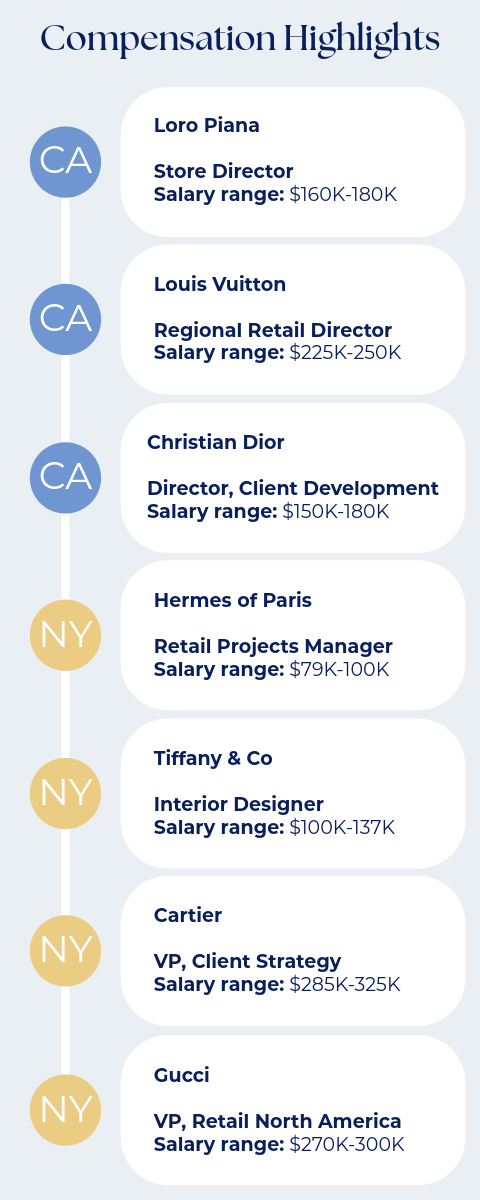
Notable Positions with Pay Ranges Above $200K:

Across the luxury retail sector, upskilling is now a top priority. The BoF/McKinsey State of Fashion 2025 report notes that retailers will focus on training store associates, including those with digital and sales skills, to enhance conversion rates. New formats, such as micro-learning modules and AI-powered courses, are being piloted to quickly bring frontline staff up to speed.

This chart compares the top-end average base hourly rate for in-store roles at select luxury brands. The data will vary over time and become more significant as new jobs with salaries are added quarterly.

The implications are clear: luxury brands must tailor recruitment and development to a blended workforce. They are investing in internal academies, online learning, and mentorship to provide Millennial and Gen Z workers with growth and purpose, while also retaining older talent through refined leadership tracks. In practice, this means that luxury companies are increasingly treating store jobs as careers, rather than just entry-level positions. With CEOs and creative leaders frequently changing, it is more important than ever that talent strategy – from pay to promotion – is aligned across the organization. Brands that prioritize multi-generational coaching and continuous learning (for example, Louis Vuitton’s retail university, Gucci’s onboarding programs, Chanel’s internal mobility drives) hope to maintain continuity amid the changes. Ultimately, the luxury sector’s success will hinge on how well it can harmonize its legacy craftsmanship with the learning needs of Gen X, Millennials, and Gen Z, ensuring every generation sees a clear, modern career path in luxury retail.


Rotational Development Programs: Building the Next Generation of Retail Leaders

An emerging theme in luxury talent strategy is the rise of rotational development programs. Once the hallmark of global banks and Fortune 500s, these initiatives are now being adapted for luxury retail—serving as structured pipelines for leadership.

I’ve had the privilege of participating in two such programs myself:

These experiences have given me a first-hand understanding of how rotational programs shape talent readiness while building loyalty to the maison.

This section serves as a preview to a future in-depth article, where I will benchmark rotational programs across luxury brands and assess their impact on talent acquisition, retention, and long-term leadership pipelines.


Closing Summary

The data makes one point clear: talent strategy is now as critical as product strategy in the luxury retail sector. From LVMH’s HR “New Deal” to Kering’s internal mobility push and Richemont’s retail academies, the industry is recalibrating pay, development, and retention to compete in an unforgiving labor market. At the brand level, Louis Vuitton, Hermès, Chanel, and Gucci illustrate both the opportunities and the risks: rising compensation transparency, generational shifts in the workforce, and leadership turnover all collide to reshape how luxury attracts and develops its people.

The report is mobile-friendly; however, it is best viewed from a desktop or tablet (temporarily open to the public, exclusive to paid subscribers).

đź”— Access now: Luxury Retail Compensation Intelligence Database

Robert Gutierrez Jr.

Robert Gutierrez Jr.

Blending academic research + frontline experience to understand how organizations shape experiences for employees & clients.

All articles

More in LRM Intelligence

See all

More from Robert Gutierrez Jr.

See all