
Author's Note
Historical Legacy: Architecture as Retail Infrastructure
As a student of luxury retail and someone deeply interested in history and philosophy, I have always been drawn to how great retail institutions become part of a city's identity. Chicago offers an unusually rich example. Its most important stores were never simply places of commerce; they became physical expressions of ambition, changing consumer culture, and the city’s own economic evolution.
That legacy developed prominently along State Street. Schlesinger & Mayer commissioned Louis Sullivan’s landmark department store at the end of the nineteenth century, a building later associated with Carson Pirie Scott. Nearby, Marshall Field & Company transformed the department store into a civic institution, combining monumental architecture with service, merchandising, dining, and spectacle. Both properties helped establish a principle that remains relevant to luxury retail today: the built environment can create economic value by shaping how consumers experience a brand and a place (Chicago Architecture Center, n.d.-a, n.d.-b).
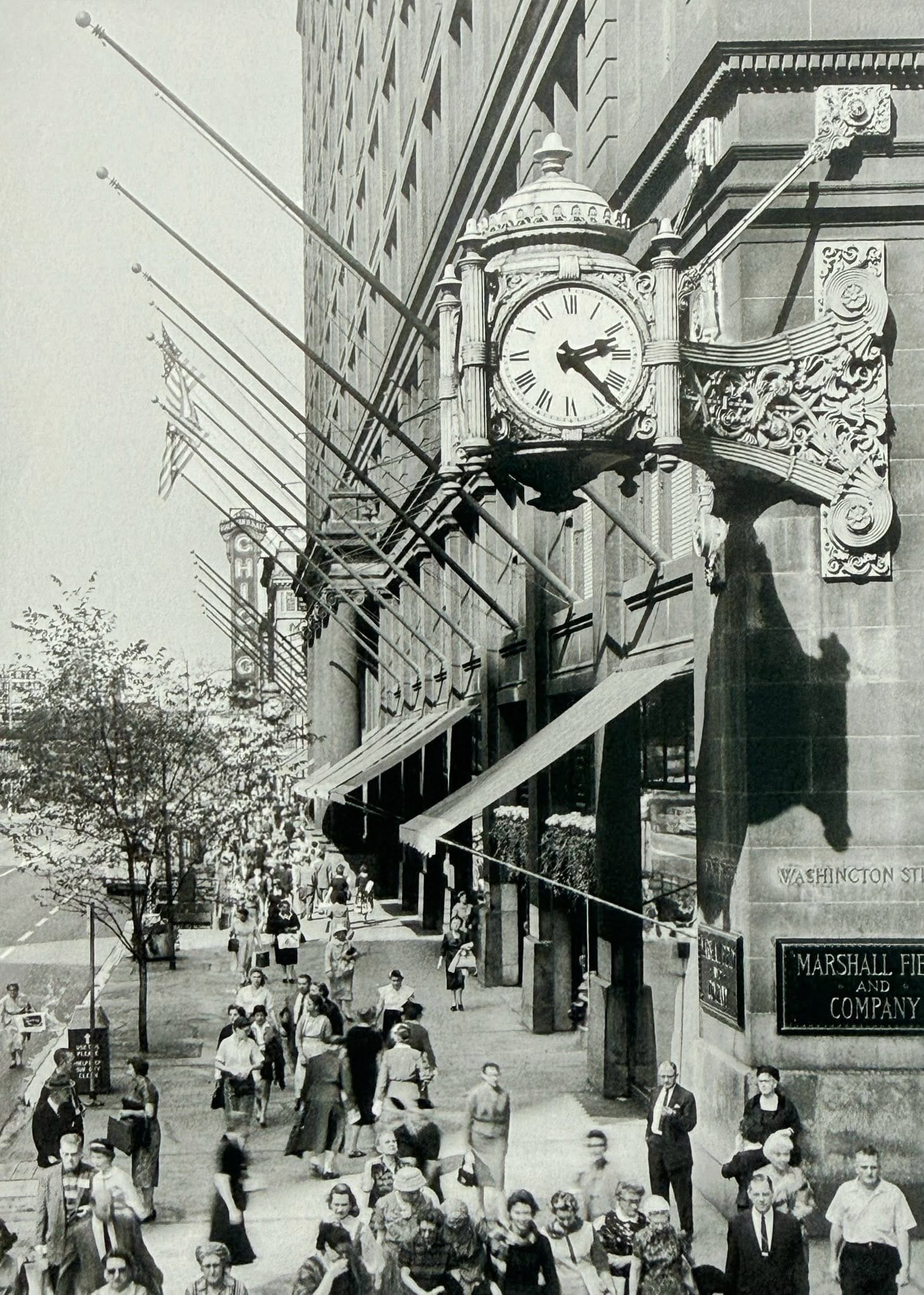
Few Chicago retailers illustrate this relationship between history, place, and reinvention more clearly than CD Peacock. Elijah Peacock founded the House of Peacock on Lake Street in February 1837, only weeks before Chicago was formally incorporated as a city. As Chicago expanded, the jeweler repeatedly moved with the commercial center of gravity, eventually serving prominent clients including Mary Todd Lincoln and Marshall Field. Even the Great Chicago Fire became part of its institutional history: its building was destroyed in 1871, but the company’s vault survived and helped the business reopen shortly afterward (CD Peacock, n.d.-a).
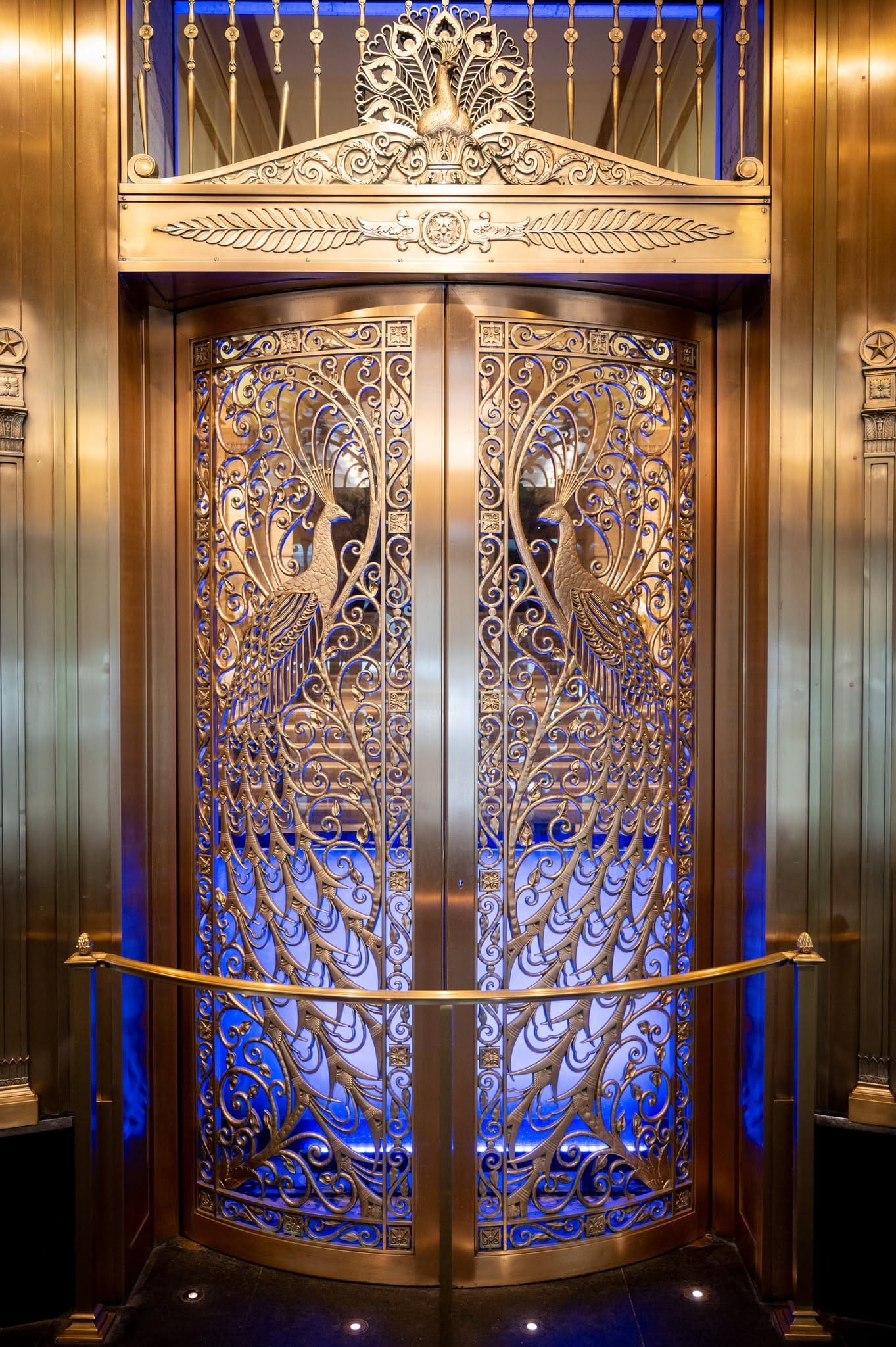
Its most architecturally significant downtown chapter came in 1927, when CD Peacock opened within the Palmer House Hotel at State and Monroe. The store incorporated bronze peacock doors commissioned from Louis Comfort Tiffany and became part of Chicago’s broader retail landscape, see photo below. That history demonstrates something I find particularly important when studying luxury: longevity rarely comes from preserving a business unchanged. Institutions endure when they retain their identity while continually adapting their physical expression to the customer and the city around them (CD Peacock, n.d.-a).
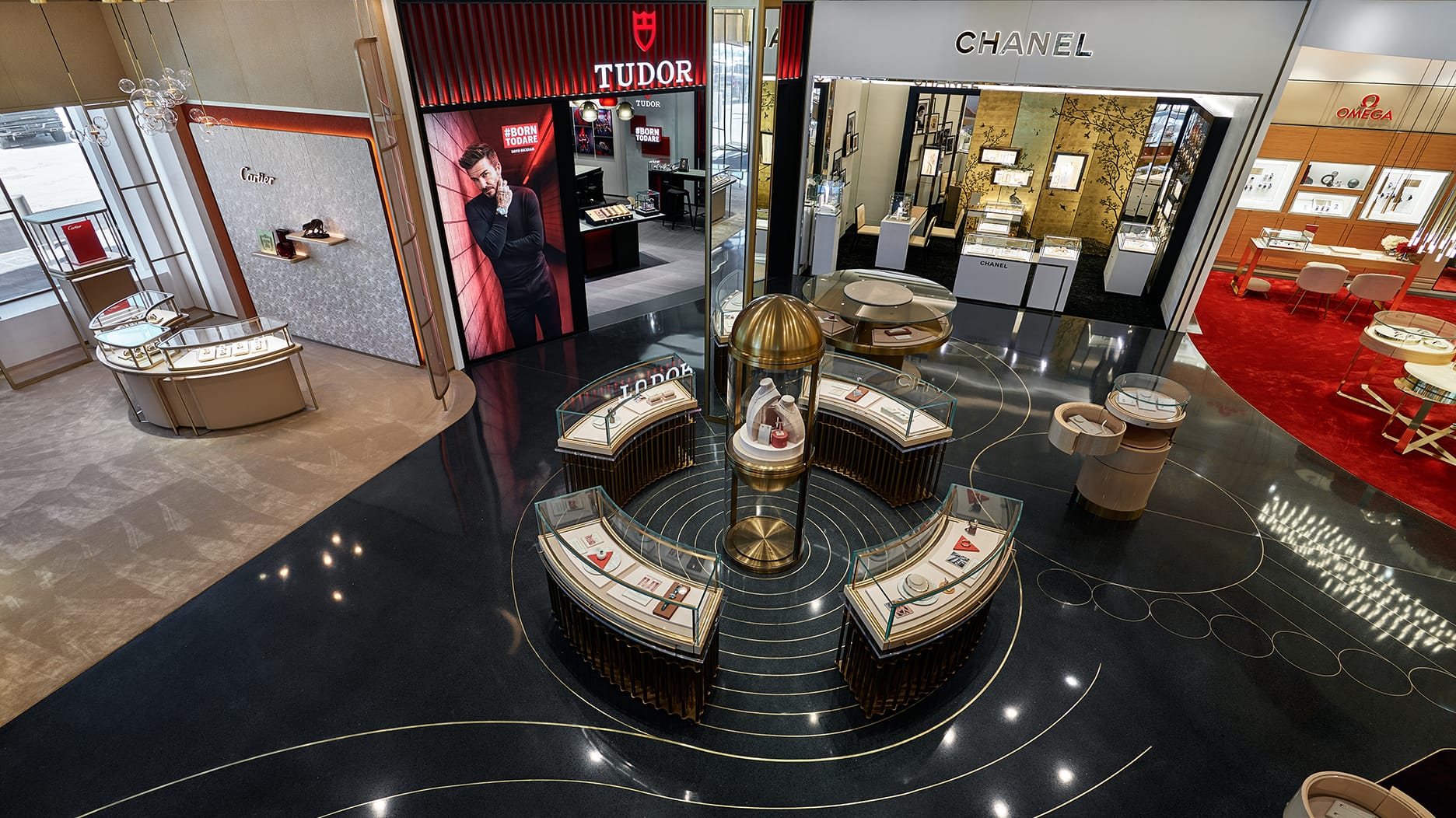
Nearly two centuries after its founding, that philosophy is visible again in the CD Peacock Mansion at Oakbrook Center. Opened in 2024, the approximately 20,900-square-foot flagship expanded the retailer from a roughly 6,000-square-foot predecessor into one of the largest independent watch and jewelry retail environments in the United States. The two-level concept incorporates dedicated Rolex, Cartier, Omega, Tudor, and Chanel spaces alongside private rooms, bridal salons, watch and jewelry servicing, hospitality areas, and a bar (National Jeweler, 2024).
Importantly, the Mansion also embeds the company’s Chicago history within the contemporary experience. The 1837 Room displays historical memorabilia, including correspondence associated with Mary Todd Lincoln, while design references throughout the flagship connect the new environment to the retailer’s institutional past (CD Peacock, n.d.-b).
Luxury Realignment
Chicago’s retail recovery is producing a more differentiated market. Michigan Avenue is attracting destination-oriented concepts, while Oak Street strengthens its concentration of relationship-intensive luxury. Plaza del Lago extends luxury retail into the North Shore. Together, these developments suggest a regional network in which each location's suitability for a particular operating model increasingly shapes investment decisions.
This is the third chapter from our 6-Chapter research series titled: The Structural Realignment of Luxury Retail & Commercial Real Estate. The structure of this series is as follows: Preface, Foreword, Prologue, Chapters 1-6 and Epilogue.
If you're just joining us, you can start by reading the Preface of the series below:
 Robert Gutierrez Jr.

Michigan Avenue: Recovery Through Reconfiguration
In January 2026, Kirsch Agency projected twice as many leasing transactions as in 2025 and a year-end vacancy rate of 23.5%. The doubling forecast concerns transaction count; it should not be interpreted as a doubling of leased square footage or achieved revenue (Kirsch Agency, 2026b).
Large experiential tenants are part of this repositioning. The Candy Hall of Fame + Experience leased more than 60,000 square feet at 830 North Michigan Avenue, with opening planned for 2027 (Kirsch Agency, 2026a).
Space configuration is equally consequential. Water Tower Place’s April 2026 redevelopment announcement outlined investment exceeding $170 million, concentrating retail on the first three floors and repositioning floors four through eight for complementary uses, including offices (Water Tower Place, 2026).
The economic implication is significant: removing space from retail inventory can improve reported occupancy independently of new retailer demand. Recovery should therefore be assessed through occupied square footage and rent commencement, alongside changes in the available inventory.
Oak Street: The Economics of High-Touch Luxury
Oak Street’s competitive position is illustrated by Cartier’s two-level, 6,460-square-foot boutique at 15 East Oak Street. Its former Michigan Avenue premises were leased to Intimissimi and Falconeri in 2026, demonstrating how individual relocations can reshape the commercial roles of adjacent corridors (Cartier, n.d.; JLL, 2026).
Cushman & Wakefield’s corridor assessment highlights Oak Street’s intimate scale and walkability. The potential advantage is concentration: clients can visit complementary houses within a compact district. This may strengthen destination appeal while supporting service environments suited to considered, high-value purchases. The effect on individual store profitability requires empirical testing.
Private-service infrastructure supports this specialization. Hermès’ October 2023 reopening on East Oak Street introduced an after-sales lounge and a confidential salon. Such spaces suggest a business model organized around sustained client engagement, with appointment capacity becoming an important consideration in evaluating store productivity.
Hard luxury—fine jewelry and watches—offers another example. In February 2026, Razny Jewelers announced its acquisition of 109 East Oak Street, following its 2024 purchase of adjacent 107 East Oak Street. Its proposed expansion would more than double its presence, incorporating private hospitality space and an enlarged Rolex offering with servicing capabilities. Financial terms were undisclosed (Razny Jewelers, 2026).
These investments suggest that control of adjoining premises can enable service capabilities that fragmented space would constrain. Ownership also commits capital and reduces relocation flexibility. The investment case depends on whether improved service capacity and sustained client spending justify those commitments.
Bulgari’s official directory still lists its Chicago boutique at 909 Michigan Avenue, underscoring that luxury continues to operate across these adjacent districts. The emerging pattern involves selective concentration within an overlapping geography.
Plaza del Lago: Extending the Regional Network
Plaza del Lago represents the redevelopment of an established asset. WS Development acquired the 1920s-era Wilmette center in 2022 and has repositioned its approximately 100,000 square feet around a refreshed tenant mix (WS Development, n.d.) Hermès opened there on August 8, 2026, while retaining its Oak Street address. This expansion shows the potential to serve suburban clients alongside an established urban flagship.
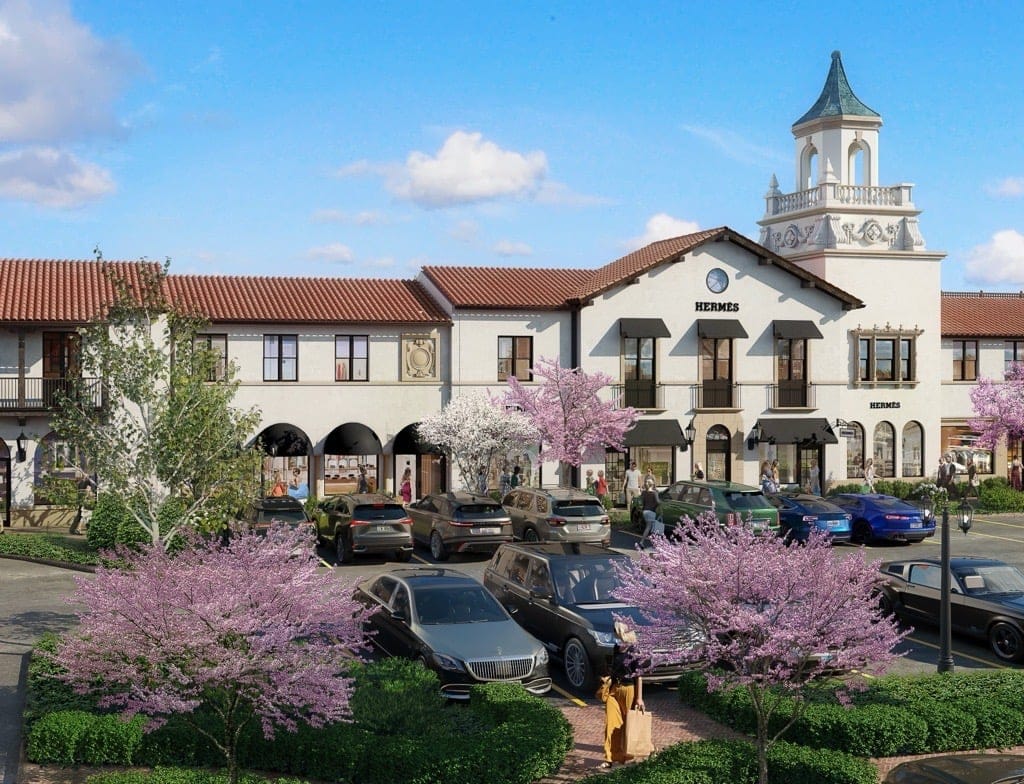
The village’s redevelopment update also identifies continuing tenants such as Jewel-Osco and CVS, placing the new luxury offering within an established neighborhood shopping environment (Village of Wilmette, 2026).
The strategic hypothesis is that proximity can support more frequent visits and deepen local relationships. Whether those visits generate incremental regional spending requires investigation: a new store may also redistribute purchases within the existing network. Client-origin data and cross-store purchasing histories would help distinguish expansion from cannibalization.
Market Evidence: Comparable Questions, Different Measures
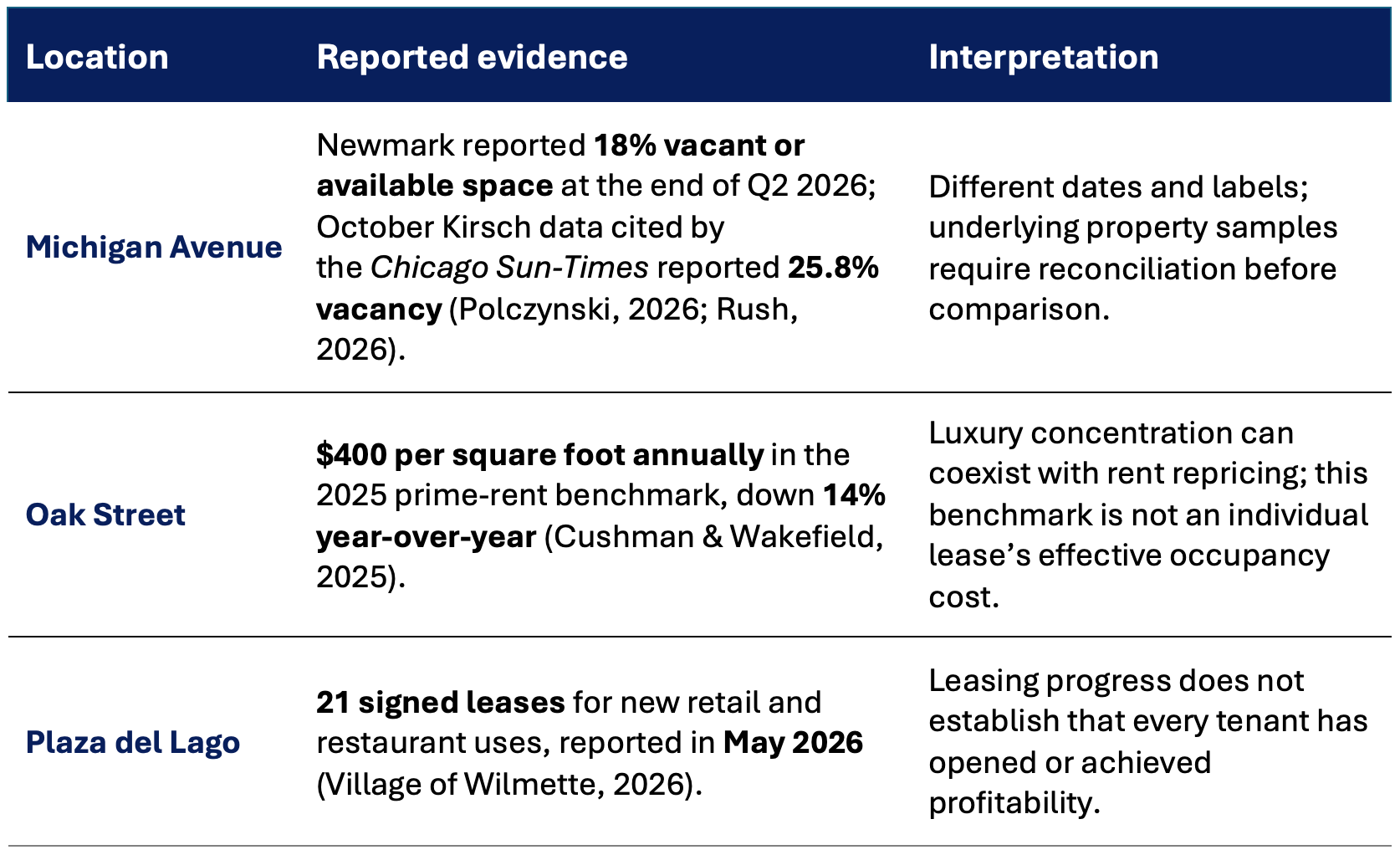
Assessing Chicago’s retail realignment requires careful attention to what each market indicator measures. The evidence below captures different dimensions of activity across the selected locations, with variations in reporting periods and geographic coverage. These distinctions help clarify the direction of market change while limiting premature conclusions about sustained recovery or investment performance.
Strategic Implications for Retailers, Landlords, and Operators
Retailers should evaluate each location’s contribution to the regional network. A destination flagship may justify space through customer acquisition and brand engagement. A relationship-intensive boutique requires a different assessment, emphasizing repeat purchasing and the cost of delivering personalized service. Suburban expansion should be tested against incremental regional contribution.
Landlords should underwrite the cost of adapting existing buildings and the durability of tenant cash flows. Large experiential leases can activate difficult space, but fit-out commitments and alternative-use value deserve explicit evaluation. Oak Street’s rent adjustment also warrants caution against assuming that prestigious co-tenancy guarantees rising returns.
Store leadership connects these property decisions to execution. Appointment-led formats require experienced advisors, sufficient preparation time, and reliable after-sales support. Capital budgets should therefore account for the staffing model needed to operate the promised experience.
Research Agenda and Closing Perspective
Two questions merit longitudinal study: Does experiential leasing increase neighboring retailers’ sales, and do suburban luxury openings expand a brand’s regional client base or redistribute existing spending?
Chicago offers a useful setting for examining both. Its emerging geography suggests that competitive advantage increasingly depends on matching real estate commitments to the client relationships each location can sustain.
Scope and Evidence
This chapter reviews selected Chicago-area corridors using sources available through November 9, 2026. Forecasts and announced projects remain distinct from completed outcomes. The reviewed sources do not establish store-level profitability or quantify aggregate luxury capital migration. The strategic implications are analytical interpretations.
Join the Conversation
We invite you to engage with Chicago’s evolving luxury retail landscape. Which market do you believe is best positioned for long-term resilience: Michigan Avenue, Oak Street, or the emerging suburban luxury nodes?
Share your perspective in the comments below.


